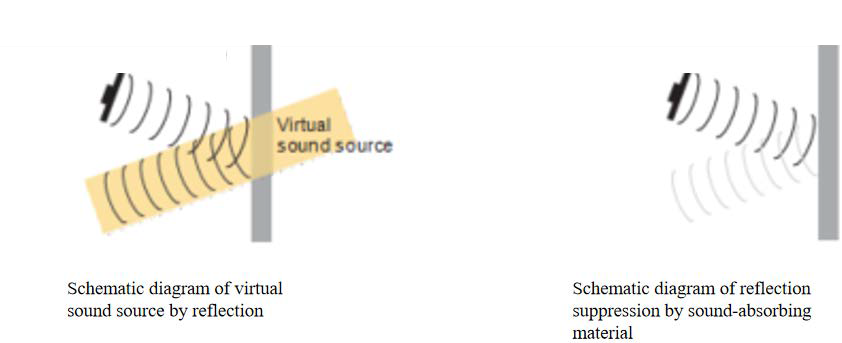
A distinctive feature of the Cube is its sound beam’s ability to use reflection off surfaces to create a virtual sound source—a perceived emission point that does not correspond to the device’s physical location.
Reflection Principle
The sound beam emitted by the Cube reflects off a flat surface in the same way light reflects off a mirror. The reflection point is then perceived by the listener as the sound source, regardless of the device’s actual position.
This mechanism allows targeting areas where direct diffusion is not possible or desirable.
Controlling Unwanted Reflections
In some installations, unwanted reflections may occur on surrounding surfaces. Applying acoustic absorbing materials to reflective surfaces is the primary method to eliminate these unwanted reflections.
Was this article helpful?
That’s Great!
Thank you for your feedback
Sorry! We couldn't be helpful
Thank you for your feedback
Feedback sent
We appreciate your effort and will try to fix the article